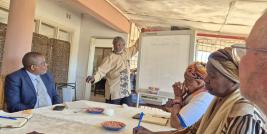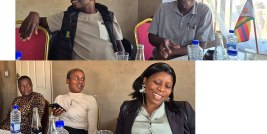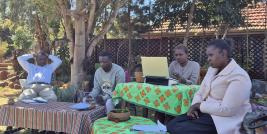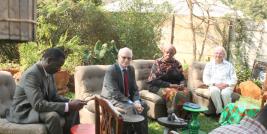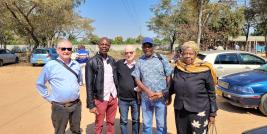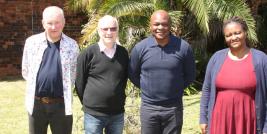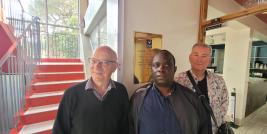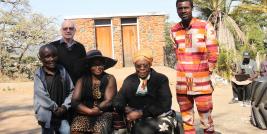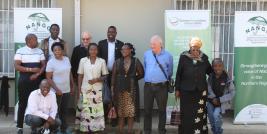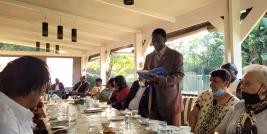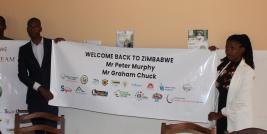
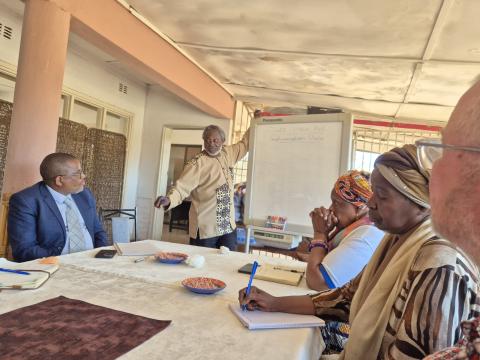
Peter Murphy and Graham Chuck met with members of the ZimPI Network Team, BEAT and the Kuwadzana West community team at the BEAT office. Also present was Bishop Sebastian Barka of the Anglican Church. BEAT has renamed itself at PMRH (Professor Mandizamba Rukuni Holdings) and structured itself into different production teams related to the concept of Rural Industrial Innovation Hubs. Some of these are finance, media, native seeds, biochemistry, coffee, and Baobab products.
The meeting explored ways to institutionalise the processes of ZimPI and PMRH, assess their current achievements and where they can engage with government and what would the budget be.
The Dual Economy Trap
The problem being addresses is the dual economy trap in which Zimbabwe and many other nations are caught – one trading economy, based in urban centres, which is wealthy, and the other rural economy, involving the great mass of the people, which is subsisting separately from the trading economy.
The identified solution is to connect the big majority of the population to an industrial system based on primary producers in the rural areas. These industries would be processing food and fibre products for sale mainly in the domestic market, and the support services needed for these industries, lifting the incomes of rural communities so that they are able to purchase the industrial products that they need.
Threshold for rural transformation
Professor Rukuni’s research has found that an income level of US$4 per day (!) is the threshold for this change. He even described people with this level of income as “middle class”. For Zimbabwe to be come an “Upper Middle Income Country” at last 50 per cent of rural people must have incomes above US$4 per day, he argued.
Further, he said that to ensure sustainable rural development, the most important investments required are in environmental and social capital, followed by economic capital. Because human beings are created by environmental capital, the environment is the primary base for development. While PMRH has the theory, he said, ZimPI has the human connection to put the theory into action, and women are the cornerstone of human capital.
Senator Holland emphasised the boy - girl partnership is the key element in this proposed development plan. In African culture, she said, the girl is raised to be a mother, and the boy is raised to be a father. That is why ZimPI includes the Boy Child Project in Partnership with the United Nations Girl Child Initiative.
Professor Rukuni declared that this plan is ready for implementation because ZimPI and PMRH have already signed a Memorandum of Agreement two years ago, and the policy of rural industrialisation is now government policy, with many Ministers agreeing to support it. ZimPI can help initiative pilot projects for rural business units through its major capacities in home economics, early childhood education, development and care, and now with the returnees from South Africa.
The Challenge of Land Titles
A more challenging aspect of the rural industrialisation plan is the provision of land titles through the Department of Land and Rural Development. This is for those formerly white commercial farms occupied by liberation war veterans and others during Mugabe’s reaction to the defeat of his Constitutional Referendum in February 2000 and the emergence of the political threat from the Movement for Democratic Change. The idea is that they would have to buy the land they are offered title to, even if they have been occupying it for 20 years or more. That is a big if. But if they had secure title, then they could obtain finance for initial investments to process their output on an industrial scale.
Professor Rukuni called for the creation of a public sector Land Bank to provide low-interest loans to support this process, and thus provide more security for commercial banks to support further productive investments. He expressed hope that Australia and other rich countries would support the proposed Land Bank.